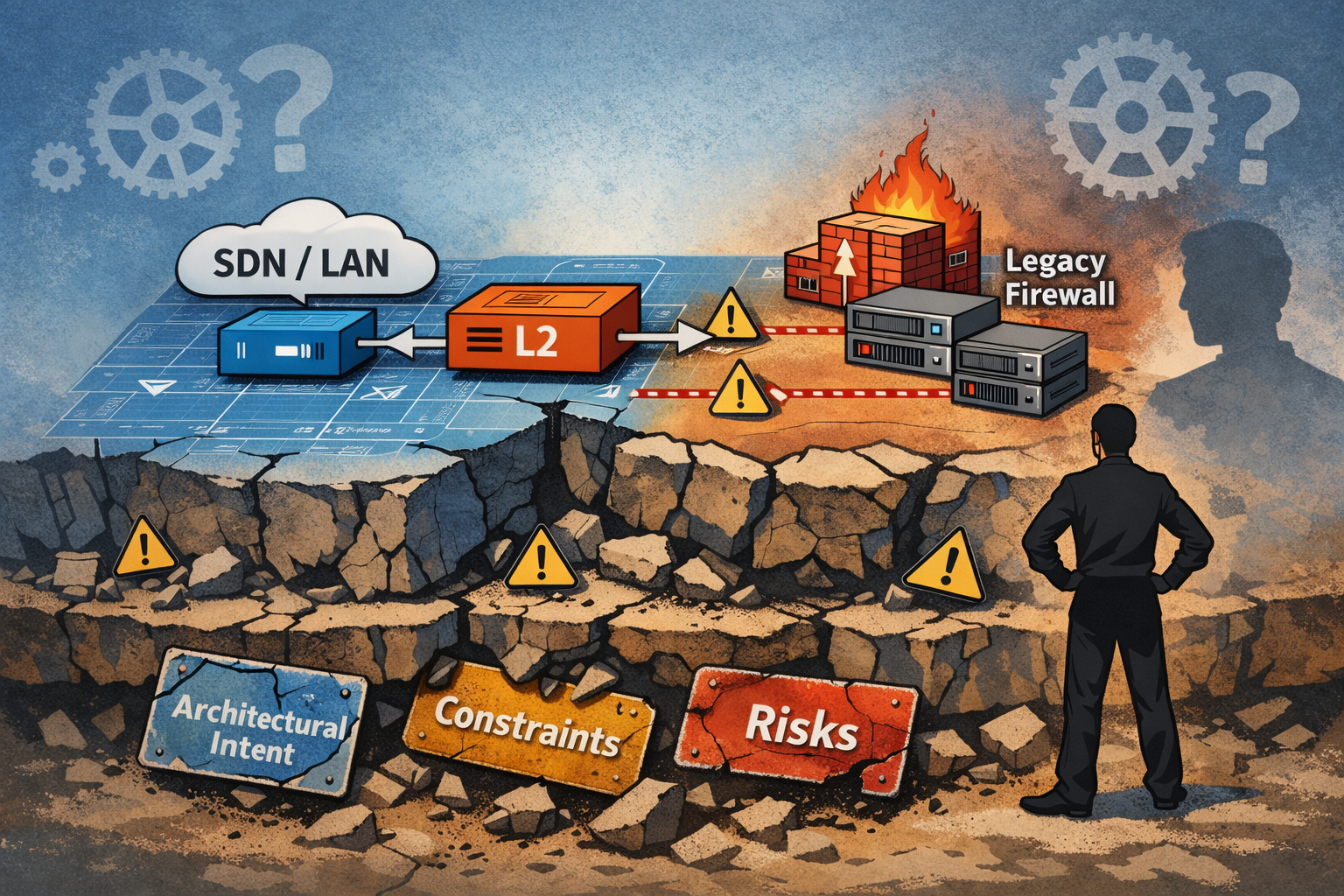
 Large transformation programs often rely on reusable design templates. In principle, that makes sense. A proven pattern should improve consistency, reduce design effort, and help delivery move faster across multiple sites.
But that only works when the template preserves more than topology.
Recently, I was involved in a follow-on site where an inherited template clearly contained structural compromises. I could see them early. The problem was not that compromise existed. Real projects always involve trade-offs. The real problem was that the design mandate was to follow the established template, while the rationale behind key design choices had not been documented clearly enough to guide architectural decisions.
That meant the next site inherited the structure, but not the reasoning behind it.
A template can preserve shape without preserving intent
The inherited pattern looked standard on paper. But several elements immediately suggested that parts of the design reflected compromise rather than clean target-state architecture.
One example was the introduction of an additional Layer 2 segment between otherwise distinct architecture domains. Another was continued Layer 2 handoff toward server-side and legacy-connected environments. In the same overall pattern, gateway ownership for dependent environments still remained in the legacy estate, along with downstream infrastructure pending replacement.
These decisions may all have been understandable in their original context.
But there was no clear record explaining whether they were driven by migration constraints, operational ownership boundaries, product limitations, cutover timing, or temporary coexistence requirements.
Without that context, the next site inherited topology without inheriting design intent.
The issue is not compromise itself
Compromise is part of architecture. No serious transformation program is built in a perfect greenfield vacuum.
The real issue begins when compromise is normalized into the template without preserving:
- why it was introduced,
- what constraint caused it,
- what risk it created,
- and under what conditions it should be challenged, retired, or redesigned.
Once that happens, reuse stops being safe standardization and starts becoming repeated ambiguity.
The follow-on site exposes what the template really is
A design can appear mature when judged only in the context where it was first produced.
The real test comes when a later site introduces new requirements or slightly different dependencies.
That is when a critical distinction becomes visible:
Is this a reusable architecture pattern?
Or is this simply a previous solution shape that has been promoted into a standard?
In this case, the inherited design was reusable enough to copy, but not interpretable enough to adapt safely.
That is a very different problem from implementation quality. It is a governance and architecture problem.
Risks that are not called out do not disappear
One of the most important lessons here is that undocumented risk does not stay neutral.
If structural compromise is not explicitly identified, later teams and customers naturally assume they are working from an approved, supportable, repeatable standard. They do not see which parts of the pattern may already contain unresolved tension between target-state architecture and historical dependency.
Then when issues begin surfacing across sites, the conversation becomes reactive.
Why does the standard still rely on legacy placement?
Why is Layer 2 adjacency being extended further than expected?
Why were these design risks not made explicit earlier?
By the time those questions are being raised by the customer, the real failure has already happened.
Not necessarily in implementation.
Not necessarily even in the original compromise itself.
But in the failure to preserve rationale, constraints, and residual risk.
Architecture must preserve more than connectivity
If a design is expected to scale across multiple sites, diagrams and topology alone are not enough.
A reusable architecture pattern should also preserve:
- the constraints that shaped it,
- the non-ideal trade-offs it contains,
- the risks introduced by those trade-offs,
- the assumptions that must remain true for the pattern to stay valid,
- and the conditions under which a later site should challenge the model.
Without that, what gets repeated is not architecture maturity.
It is undocumented compromise at scale.
Final thought
Compromise is not the enemy of architecture.
Undocumented compromise is.
A reusable template must preserve more than the physical or logical layout of a design. It must also preserve intent, known constraints, and accepted risks. Otherwise, every follow-on site may inherit not just structure, but defects.
That is where enterprise architecture still matters most: not in drawing the first template, but in ensuring the next team knows what must stay, what can change, and why.